Transition from Equities to Treasuries
Capstone Strategy Capital Allocations
When investing in the Capstone Program (which combines the Cornerstone Equities Strategy and Keystone Options Strategy), it can sometimes be a bit confusing as to how much capital is being allocated to each Strategy.
Some of this confusion can be attributed to the advanced money management techniques we are able to deploy by using portfolio margin.
==================================
When trading a portfolio margin account, we must continually be aware of two account balance components:
Component 1 is our Option Buying Power
Component 2 is our Available Cash
When we trade different products (i.e. Options versus Equities versus Treasuries), these products consume different amounts of Option Buying Power and/or Available Cash.
For example: When we trade the Keystone Options Strategy, this strategy consumes a large amount of Option Buying Power, but consumes very little Available Cash.
When we trade the Cornerstone Equities Strategy, this strategy consumes a lot of Available Cash, but very little Option Buying Power.
So if we were to trade these strategies individually, we wouldn’t be efficiently utilizing all of our available Option Buying Power and/or Available Cash... but when these strategies are combined, we can very effectively utilize both components.
==================================
NOTE: The information below is how we CURRENTLY trade the Capstone Combination Program (using the Keystone Options Strategy + Cornerstone Equities Strategy). Later, we will present how we intend to modify this approach to replace the Equities with Treasuries.
==================================
In general, the Keystone Options Strategy uses 80% of the entire portfolio's Option Buying Power and 20% of the Available Cash... and the Cornerstone Equities Strategy uses 80% of the entire portfolio's Available Cash and 20% of the Option Buying Power.
==================================
To help explain this a little better, let's set up an example of how we would construct a $100,000 portfolio.
1) We invest $80,000 (of our $100,000 portfolio) into the Keystone Options Strategy. This means we are consuming up to $80,000 (80%) of our Option Buying Power to enter into our option positions... but... these option positions will only consume about $20,000 (20%) of our account's Available Cash.
2) We then invest $80,000 (of our $100,000 portfolio) into the Cornerstone Equities Strategy. This means we are consuming up to $80,000 (80%) of our Available Cash to enter into our stock/bond/ETF positions... but... these positions will only consume about $20,000 (20%) of our account's total Option Buying Power.
This advanced money management technique is made possible by the use portfolio margin, allowing us to utilize much of our capital "twice" across two different Strategies WITHOUT using traditional margin or incurring any margin fees/costs.
==================================
The information below is how we INTEND to modify the Keystone Options Strategy and Cornerstone Equities Strategy to take advantage of the recent rise in interest rates.
==================================
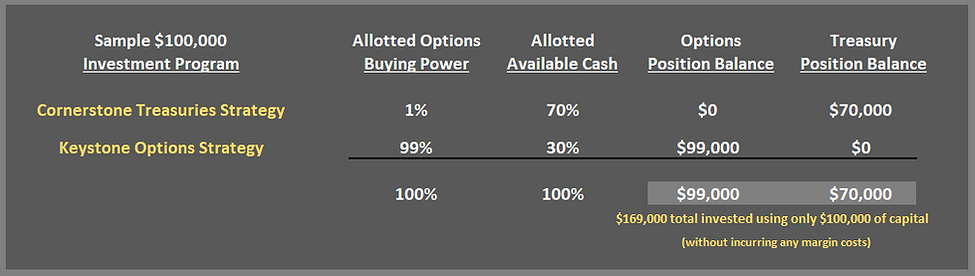
Our new approach is to replace the Equities component of the Cornerstone Equities Strategy with 6-12 month US Treasury Bills. Since treasury bills carry very little risk, they only consume a fraction of the Option Buying Power that the Equities do. This allows us to now allocate 99% of the Option Buying Power to the Keystone Options Strategy (instead of the original 80%).
So when we put this new approach altogether, we can now allocate 99% of the Option Buying Power and 30% of the Available Cash to the Keystone Options Strategy.
We can then allocate the remaining 70% of the Available Cash and 1% of the Option Buying Power to the Cornerstone Treasuries Strategy.
Another way to look at this is that we are trading 99% of the account in the Keystone Options Program (which is the primary intent for the portfolio), while having the +/- 3.6% annual return of the Treasuries as pure bonus income.
==================================
To be clear, as with any trading strategy, there are always risks. In our case there is the potential that an unlikely combination of events could cause the trading account to consume all of its Available Cash, in which case the portfolio would temporarily need to use actual margin to maintain the positions. A situation like this does not present a material risk to the portfolio or the trading program, but the account would incur some margin interest costs which would negatively impact the income potential of the Treasury positions for a period of time.
A scenario like this is unlikely, but it is possible... and is something we will carefully monitor and mitigate.